

Europe · Italy
Picture-Perfect Hidden Spots in Rome
The best photo locations for your city walk — angles, terraces, and quiet corners most visitors walk straight past.
Rome doesn’t really have “secret” spots — this is a city that’s been photographed for two thousand years. But it does have angles, terraces, and quiet corners that most visitors walk straight past on their way to the next checkbox landmark.
This guide is a walking list of the viewpoints, frescoes, and golden-hour corners that turned my trip into a photo diary I actually want to look back on.
1. The Palatine Hill Viewpoint Over the Forum
Start here. From the raised terraces of the Palatine Hill, you get a sweeping view down over the Roman Forum’s fallen columns and brick ruins. If you time it for late afternoon, the light rakes low across the ruins and turns the old brick a deep amber.


2. The Cypress-Lined Path to the Garibaldi Monument
Away from the ruins, Rome’s hills hide quieter, greener corners — a path lined with tall cypress trees leading up to a bronze equestrian monument, framed dead-center between two walls of dark green.

3. A Cobblestone Street Framing a Dome
Rome’s narrow streets do the composition work for you — standing at the top of one looking down toward a domed church, cars parked tight along both sides, a scooter buzzing past. It reads like a perfectly composed photograph without any effort.


4. Inside the Colosseum, From Above
Everyone photographs the Colosseum from outside. From the upper tiers looking down into the oval arena floor, you get a sense of the sheer engineering that exterior shots don’t capture — layered arches receding into the distance, the sky opening above.


5. A Rooftop Panorama Over the Terracotta Skyline
Rome rewards anyone willing to climb. From a high vantage point you get an ocean of terracotta rooftops, church towers punching up above the roofline, and hazy hills in the far distance — a completely different Rome than street level.


6. Via Condotti’s Christmas Lights
In winter, Rome’s shopping streets are dressed in elaborate golden light installations — swirling wire-and-bulb sculptures strung above the crowds. Shot from a slightly elevated angle, the golden ornaments create a glowing tunnel effect over the shoppers below.


7. The Trevi Fountain, Up Close
Getting close enough to fill the frame with just the sculptural detail makes for a far more striking photo than the standard wide shot. Up close, the baroque scale is staggering — muscular figures mid-motion, water crashing over travertine rock.

8. The Palace of Justice From Ponte Umberto I
The Palazzo di Giustizia sits right on the Tiber, its facade topped with a dramatic bronze chariot sculpture. At golden hour from the bridge across the river, with the arches in the foreground and the building glowing warm, it’s a striking and far less crowded alternative to the usual landmarks.


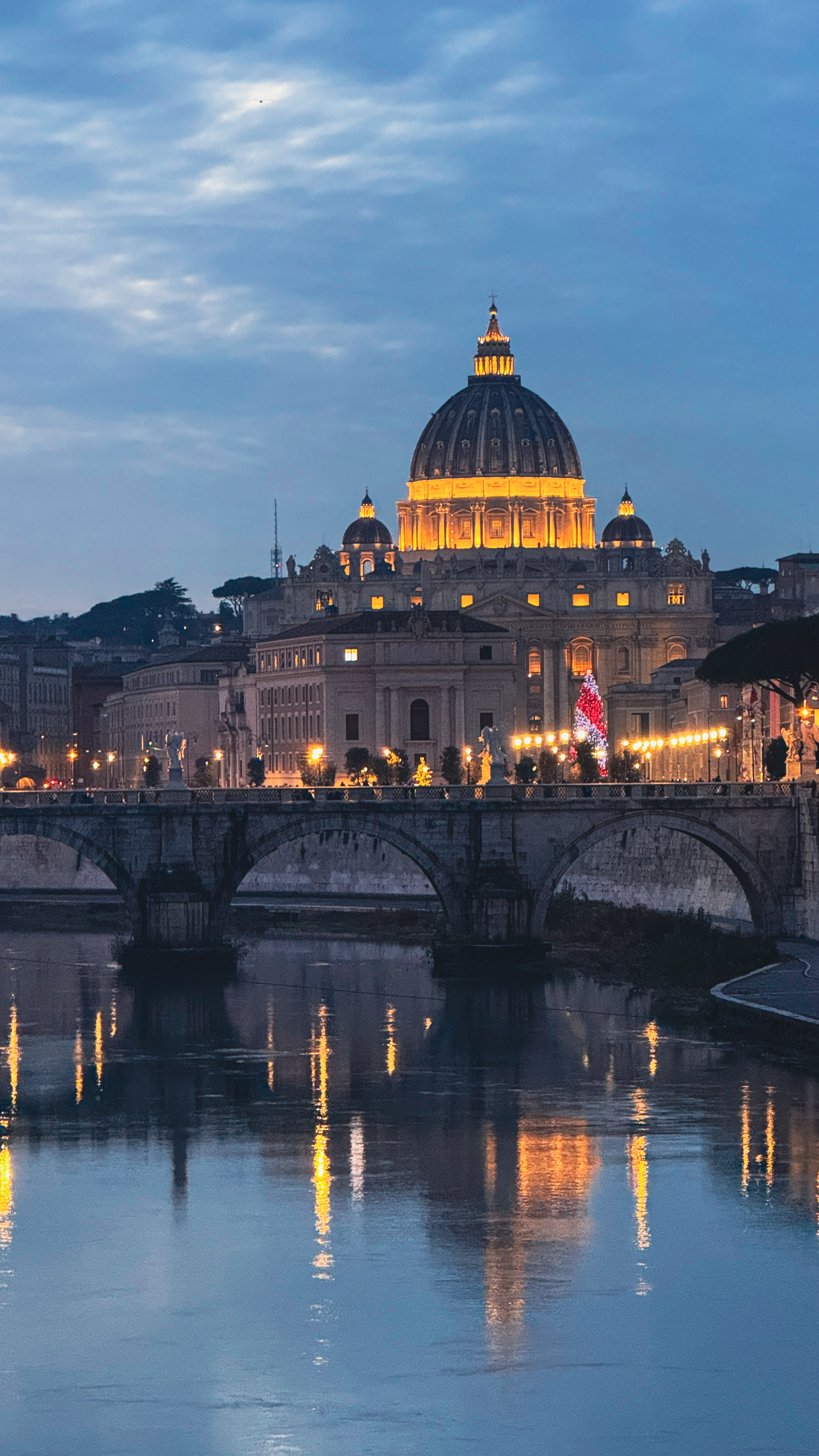
9. St. Peter’s Dome From the Tiber Bridges
St. Peter’s Basilica dome framed by one of the arched stone bridges over the Tiber — this shot works at every time of day. Soft and moody at dawn, golden at sunset, or lit up and glowing against a deep blue night sky in December.


10. Castel Sant’Angelo at Golden Hour
The cylindrical fortress turns a deep warm ochre as the sun drops, its bronze angel statue catching the last light on top. From across the Tiber with its reflection rippling below, it looks almost fortress-from-a-storybook.


11. The Pantheon’s Oculus
Inside the Pantheon, the coffered dome spirals up to a single open circle — the only source of light for the entire interior. Shooting straight up, the concentric rings pull your eye toward that bright circle of sky like a giant sundial.


12. The Ceiling of Sant’Ignazio
Less famous than the Sistine Chapel but no less jaw-dropping — the ceiling fresco is a masterpiece of trompe-l’œil illusion. Even the dome over the crossing isn’t a dome at all: it’s a flat painted illusion so convincing it’s genuinely difficult to tell from the right spot on the floor.


13. A Quiet Ledge With the Best View in the City
Sometimes the best photo spot isn’t a landmark — it’s a random brick ledge on the Palatine Hill, with cypress trees and the Colosseum rising behind. The kind of spot you find by wandering, and a far better portrait backdrop than fighting the crowds at the amphitheater itself.

Final Tips for Photographing Rome
Chase golden hour deliberately. Rome’s warm stone and terracotta rooftops come alive in that hour after sunrise and before sunset.
Revisit landmarks at different times of day. St. Peter’s, Castel Sant’Angelo, and the Colosseum all look like different buildings at dawn, midday, or lit up at night.
Look up, and look for frames. Rome’s narrow streets naturally frame domes and towers — half the composition work is already done for you.
Don’t skip the ceilings. Some of the city’s most spectacular art is directly overhead in its churches, and it’s almost always free to walk in and look up.
Save this guide for your own Rome itinerary, and let me know in the comments which of these spots you’d shoot first.
Leave a Reply